Wednesday, November 28, 2012

Tuesday, November 27, 2012
Land Use
Land Use Definition
Land use is the human use of land, land use involves the management and modification of natural environment or wildness into built environment such as fields, pastures and settlements. It has also been defined as "the arrangements activities and inputs people undertake in a certain land over type to produce, change or maintain it"

Land use is the human use of land, land use involves the management and modification of natural environment or wildness into built environment such as fields, pastures and settlements. It has also been defined as "the arrangements activities and inputs people undertake in a certain land over type to produce, change or maintain it"
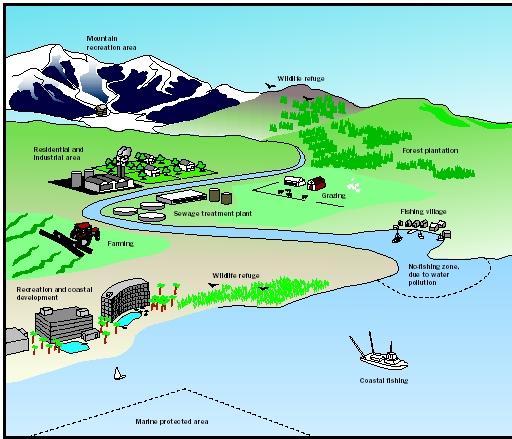
Land Use, http://www.waterencyclopedia.com/La-Mi/Land-Use-Planning.html#b
Impact of land uses
Natural vegetation, such as forest cover is usually the most benign of land uses, with higher infiltration and reduced runoff rates. The opposites of forest cover are urbanized areas, where large surface areas are impermeable, and pipes and sewer networks augment the natural channels. The impervious surfaces in urban areas reduce infiltration and can reduce the recharge of the groundwater. In addition, urban runoff contributes to poor water quality.
Agriculture activities are major forms of land use, including row crops, rangelands, animal farms, aquaculture and other agribusiness activities. Cropping activities involve soil and water manipulation through tillage and irrigation, thereby affecting runoff water and groundwater resources. If improperly used , fertilizer and plant protection chemicals in agricultural operations can affect water resources and ecosystems.
Land use, land types and land usage.
Land can be used for a variety of usages and factors such as soil type, location, size and access can all impact on land usage.
1, Agricultural Land Use
Agricultural land use is separated into two different categories, arable land and pasture land. Agricultural land follows an Agricultural land system.
2, Grazing Land Use
Grazing land can be either lush grassland or arable land that has been seeded.
3, Paddocks Use
Paddocks are generally small acreages of grazing land.
4, Recreational Land Use
Recreational land use can be used for a wide range of activities, including quad biking, off roading, archery or for a simple gathering of family and friends.
5, Woodland Use
Woodland can be used for a wide range of outdoor activities.
6, Strategic Land Use
Strategic Land is arable or pasture land that can be used for any of the land uses above.
Monday, October 29, 2012
Cricket Lighter

Image 1: A lighter, Available on Wikipedia.
Let's talk about lighters, A lighter is a portable device used to generate a flame. It consists a metal or plastic container filled with a flammable fluid or pressurized liquid gas, a means of ignition, and some provision for extinguishing the flame. Lighters are very daily used for smokers, people who don't smoke might have a lighter somewhere in the house as well, lighter is a very daily-used item.The first lighter were invented in the 16th century. One of the first lighter were invented by the German chemist named Johann Wolfgang Dobereiner in 1823. This lighter worked by passing flammable hydrogen gas, produced with the lighter by a chemical reaction over a platinum metal catalyst which in turn cause it to ignite and give off a great amount of heat and light. The device was very large and highly dangerous and fell out of production by the end of the 19th century.
There are many types of lighters nowadays, for example.

Image 2: Automobile Lighter, Wikipedia
Some automobiles are equipped with an electric lighter house in a 12 receptacle. Its electric element becomes not in seconds upon activation. The car lighter was claimed to have been invented by Alexander Kucala, a tavern owner/inventor, on the south side of Chicago in the early 1920's called the AL Lighter.

Image 3: Flameless Lighter, Wikipedia
A flameless lighter is a safe alternative to traditional lighters, The flameless lighter uses an enclosed heating element, thus, the device does not emit an open flame, Typical flameless heating elements are an electrically heated wire or an artificial coal.
Flameless lighters are designed for use in any environment where an open flame must not exist or where conventional lighters or matches are not permitted. The flameless lighter is used in many environments such as prisons and detention facilities, oil and gas facilities, mental health facilities, nursing homes air ports and night clubs/restaurants.
The flameless lighter was invented by brothers Douglas Hammond and David Hammond in the UK 1966 under the "Ciglow" name.

Image 4: Permanent Match, Wikipedia
A typical form of lighter is the everlasting match, consisting of a naphtha fuel-filled metal shell and a separate threaded metal rod assembly - the "match" -serving as the striker and a wick. This metal match is sorted screwed into the fuel storage compartment, the shell.
Lighters have such a long term history, what is lighter for? For the flame.

Image 5: Cricket, http://www.exchange3d.com/lighter-3d-model/prod_3330.html?act=viewProd&productId=3330
Let's talk about Cricket, Everyday some 200 million people in 140 countries use a cricket lighter, the lighter represents quality and safety, Cricket, known around the world. All Cricket lighters sold worldwide have undergone over 60 quality tests and are ISO 9994 certified.
In 1961, Cricket was the first disposable lighter brand in the world. The birth of the maxi lighter was in 1977. The brand named Cricket in 1985, Swedish Match acquired the brand name Cricket from Gillette, Cricket has since become the global lighter brand for Swedish Match lighter products. In the late 80's Swedish Match launched the Cricket original and Electronic lighter.
 Image 6: Cricket Maxi Lighter, http://www.smokerssupplies.com.au/products/accessories/lighters/cricket?product=maxi-simplicity-50s

Image 7: Cricket Electronic Lighter, http://www.mystoresupplier.com/CRICKET_ELECTRONIC_MINI_LIGHTERS_25_COUNT_p/lit059.htm

Image 8: Lighter Environmental Damage, http://everydaytrash.com/tag/beach-debris/

Cricket has got so many different products and so many different designs and logos on the surfaces to get more people to buy, the usual ones you normally see around our life is the name "Cricket" on the surface as an advertising usage for people to know about the brand and brand's name. Cricket lighters have got so many different and vabrant colors for the costumers to choose; personally I like Cricket designs and packaging, though one thing has to be improved, Cricket lighters are usually disposable, and it's big harm for our environment.
Thus, I suggest people to use Zippo Lighters

Image 9: Zippo-lighter, http://www.blogsdna.com/1063/download-free-virtual-zippo-lighter-iphone-application.htm
A Zippo lighter is a refillable metal lighter manufactured by Zippo Manufacturing company of Bradford, Pennsylvania, U.S.
The Zippo lighter and company were invented and founded by George G. Blaisdell in
1932. The Zippo was noted for its reliability, "Life Time Warranty" and Marketing as "wind-proof" Most early Zippos naphtha as a fuel source.
Zippo lighters are usually a bit expensive, but they are refillable lighters which means no need to dump them away after once use, Zippo has got many different designs and logos on the surfaces as well, it can be stylish for the young adults, it can be classic for the business men, it can also be pinky for female smokers.
So my suggestions is to use Zippo or some other refillable lighters to light to save our environment.
Subscribe to:
Posts (Atom)